The Critical Importance of Departmental Formats for the Security of Liberty and the Protection of Assistants per Employee Performance

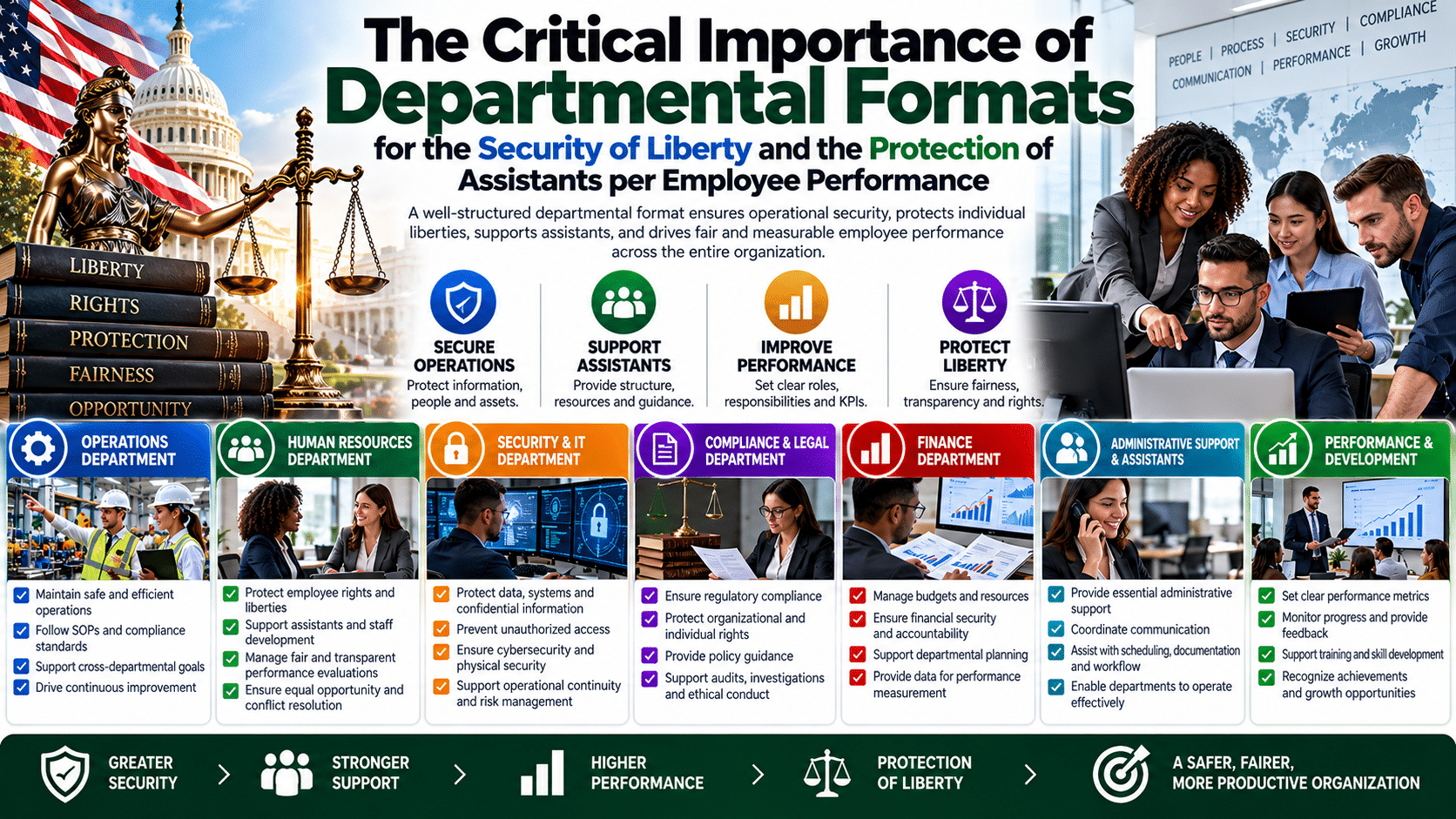

In every thriving organization, the integrity of performance reviews shapes not just employee growth—but the trust between management, assistants, and the larger operational system. By 2030, as digital transformation deepens across industries, performance reviews are no longer just a managerial routine—they are a strategic safeguard for liberty, protection, and workplace transparency.
At the heart of this transformation lies one key principle: having a standardized performance review format per department. When structured correctly, these formats don’t just measure output—they protect assistants, ensure ethical decision-making, and establish fair grounds for recognition, discipline, and development.
The modern workplace demands systems that are secure, compliant, and fair. Department-based review formats serve as the cornerstone of organizational accountability, preventing bias, reinforcing meritocracy, and strengthening every assistant’s right to liberty and fair assessment.
Performance reviews, when implemented correctly, transcend numbers and charts. They become a mechanism of liberty protection—ensuring that every employee, regardless of title or tenure, is treated under a transparent and equal system of measurement.
Assistants, often the backbone of administrative and operational workflows, are among the most vulnerable to inconsistent evaluation systems. Without standardized review formats, their performance can easily be overshadowed by departmental politics, subjective judgment, or vague performance expectations.
A well-designed departmental review format provides:
When organizations ignore the importance of structure, assistants risk becoming invisible assets—essential, yet unprotected. Liberty in the workplace is not only about personal rights but also about structural fairness embedded in policy and documentation.
Each department within a company operates with unique objectives, workflows, and skill expectations. A one-size-fits-all review form cannot capture the nuances of different functions.
For example:
Developing customized departmental performance review formats ensures that evaluation criteria match the operational realities of each role. When assistants are evaluated using the right metrics, their contribution becomes measurable, visible, and respected.
A structured departmental format typically includes:
This structure transforms performance reviews from a judgmental formality into a security instrument—one that protects the assistant’s professional standing through evidence-based assessment.
In the digital age, the term security extends beyond physical protection to include data, emotional well-being, and professional integrity.
A departmental review format becomes a documented line of defense against exploitation, misjudgment, or data misuse. When properly standardized, it:
Assistants, especially those managing executive or financial information, need structured performance records that are both securely stored and auditable. This protects them from liability in cases of disputes or miscommunication.
For organizations aiming for ISO 9001 or ISO/IEC 27001 compliance, a departmental performance review format serves as a dual-purpose document—aligning with both quality management and information security controls.
The liberty principle is founded on the belief that every worker should have freedom through fairness—the ability to grow and make decisions within a system that respects equality, privacy, and professional integrity.
A departmental review process embodies this principle by:
Liberty in organizational culture is not about lack of control—it’s about structured freedom, made possible through procedural fairness and data-driven evaluation.
Performance reviews often act as legal and ethical shields in employment management. Without clear documentation, a company risks noncompliance with labor laws, wrongful termination claims, or data breach liabilities.
Each departmental review format must include sections that verify:
These measures ensure the organization meets standards of liberty, justice, and compliance, reinforcing both employee protection and corporate integrity.
When the format itself is recognized as an operational policy, it can protect not just the assistant, but also the manager and company from ethical risk.
Let’s consider an example scenario:
An administrative assistant in the Operations Department oversees vendor communications, schedules maintenance, and manages documentation for ISO audits.
Without a departmental review format, her performance could be unfairly judged by metrics unrelated to her role—such as sales targets or creative output.
But with a department-specific review template, her performance would be evaluated through:
This format becomes her shield of professional liberty—protecting her from misinterpretation and providing a fair path for growth.
The same applies to virtual assistants, executive assistants, and technical support staff. When review templates align with departmental objectives, assistants gain measurable visibility within the company’s strategic performance framework.
Standardized departmental reviews do more than protect individuals—they transform organizational culture.
Transparency builds trust.
Employees understand how their performance connects to organizational goals.
Fairness builds loyalty.
Assistants and employees feel recognized for the right reasons, leading to longer tenure and stronger morale.
Documentation builds credibility.
External auditors, clients, and stakeholders view the company as ethical and professionally governed.
When employees see that performance evaluation is not a tool for punishment but a platform for empowerment, engagement rises dramatically.
Organizations that implement departmental formats report:
Thus, performance review templates evolve from simple HR tools into pillars of ethical infrastructure.
For companies like SoftSOP.com LLC, integrating performance review formats into the Standard Operating Procedure (SOP) Index is essential for maintaining both quality and information security standards.
According to ISO 9001, organizations must maintain documented evidence of employee competency and performance review processes. Similarly, ISO/IEC 27001:2022 mandates strict controls on how personnel performance data is managed and stored securely.
Each department should maintain a unique but interconnected Performance Review SOP, which includes:
Embedding these review SOPs within the company’s operational ecosystem ensures audit readiness, regulatory compliance, and ethical workforce management.
Assistants are not just subjects of performance review—they are often custodians of its process.
In many organizations, assistants prepare performance documentation, organize evaluation schedules, and manage data confidentiality. Hence, they are responsible for ensuring that:
By maintaining the chain of custody for performance records, assistants contribute directly to the security and liberty of the entire review process.
This professional duty underscores why departmental review formats must include protection clauses for assistants—to prevent coercion, misuse, or undue influence from superiors.
Performance reviews can be stressful. Without structure, they can create anxiety, self-doubt, or even workplace tension.
However, when conducted within a structured and liberty-centered framework, they provide psychological safety—a space where assistants and employees can speak honestly without fear of retaliation.
Ethical leadership demands that performance review formats incorporate:
Leaders must understand that reviews are not tools for dominance, but instruments of development, empathy, and growth.
In the 2030 workforce landscape, companies that fail to integrate emotional intelligence into performance review formats risk losing top talent to more humane, structured competitors.
As organizations move toward automation, performance reviews are increasingly managed through digital platforms—often integrated with HR dashboards, analytics, and AI-driven performance trackers.
However, automation should enhance, not replace, the human essence of performance review.
A digital departmental review system should ensure:
Such systems provide assistants and employees with peace of mind—knowing their evaluations are not manipulated, lost, or exposed without consent.
When the system is transparent, the liberty of the employee is secured by design.
By 2030, performance review systems will evolve from reactive evaluation tools into predictive, fairness-driven ecosystems.
Future departmental formats will include:
In this vision, the security of liberty will not be a philosophical goal—but a data-backed standard, embedded within every operational and human resource process.
Assistants and employees alike will work under systems that respect autonomy, reward merit, and document growth as a shared journey.
Performance reviews are not just administrative requirements—they are the contracts of fairness that define modern organizational ethics.
Having a department-specific performance review format is a moral and operational necessity. It ensures:
As companies like SoftSOP.com lead the digital and procedural revolution, the message is clear: freedom in the workplace is not the absence of rules—it’s the presence of fair, structured, and secure systems.
Performance reviews, when guided by departmental formats, become not just records—but guardians of dignity, justice, and professional liberty.