Document Control in Food Safety

August 19, 2025
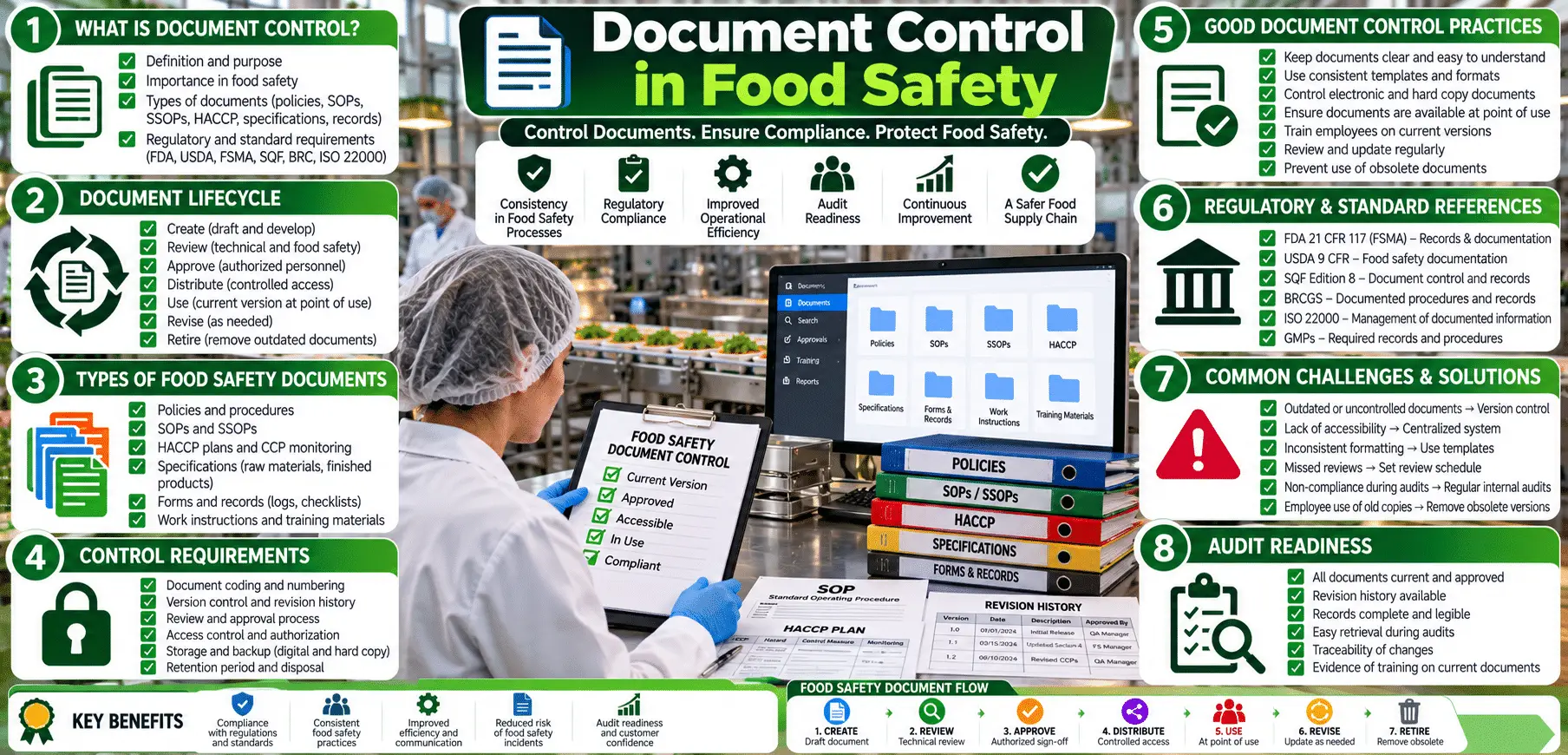

Food safety is paramount in the modern food industry, where global supply chains and stringent consumer expectations demand unwavering quality and regulatory compliance. A well-structured food safety management system (FSMS) is essential, with documentation playing a central role. Among the various documentation tools, the Food Safety Document Control Master List stands out as a critical component for ensuring compliance, operational efficiency, and risk management.
Document control in food safety involves the systematic management of policies, procedures, records, and other documents that guide food safety operations. Its primary purpose is to ensure that the right documents are accessible to the appropriate personnel at the right time and that outdated or obsolete versions are removed from circulation. Ineffective document control can lead to inconsistencies in safety procedures, increasing the risk of contamination, non-compliance with regulations, and potential harm to consumers.
Regulatory frameworks such as the Food Safety Modernization Act (FSMA), FDA Current Good Manufacturing Practices (CGMP), ISO 22000:2018, and Hazard Analysis and Critical Control Points (HACCP) principles emphasize the importance of proper documentation to demonstrate compliance and ensure traceability. Regulatory agencies frequently cite poor document control as a common reason for non-compliance during audits.
The Food Safety Document Control Master List (e.g., FSF_009) is a centralized register that tracks all food safety-related documents within an organization. This list ensures that every document—whether a chart, work instruction, checklist, or audit log—is accounted for, updated, and approved. Each entry typically contains:
This structure prevents confusion, duplication, and unauthorized use of outdated procedures, ensuring full traceability and compliance.
The Master List is crucial when integrating with frameworks such as HACCP and ISO 22000. Both systems require documented evidence of hazard controls, critical control points (CCPs), corrective actions, and verification activities.
Maintaining a centralized Master List demonstrates alignment with these standards, facilitating smoother audits and ensuring international recognition of food safety practices.
Without a Master List, organizations face numerous challenges:
These risks not only threaten compliance but also compromise consumer trust, leading to reputational damage.
To maximize the effectiveness of a Food Safety Document Control Master List, businesses should adopt the following best practices:
As digital transformation continues, many businesses are shifting from paper-based Master Lists to electronic document management systems (EDMS). These systems integrate with quality management software, allowing real-time updates, automated notifications of document revisions, and easy retrieval during audits. However, the principles remain the same: accuracy, accessibility, and accountability.
For organizations that are not yet fully digital, Excel-based or PDF Master Lists remain practical and effective tools. What matters most is consistency in updating and maintaining the records.
The Food Safety Document Control Master List is more than just a register of forms and checklists—it is the foundation of a compliant, efficient, and transparent food safety management system. By centralizing all critical documents, ensuring accountability through approvals, and maintaining traceability through revision histories, the Master List supports regulatory compliance, operational consistency, and consumer trust.
In an industry where even minor lapses in safety can have catastrophic consequences, document control provides the assurance that every inspection, audit, and corrective action is properly recorded and accessible. Whether integrated into a digital platform or maintained in a well-structured manual system, the Master List remains a cornerstone of modern food safety management, enabling organizations to safeguard public health while sustaining operational excellence.