The Chemical Usage Master Log: A Critical Tool for Chemical Control in Food Facilities

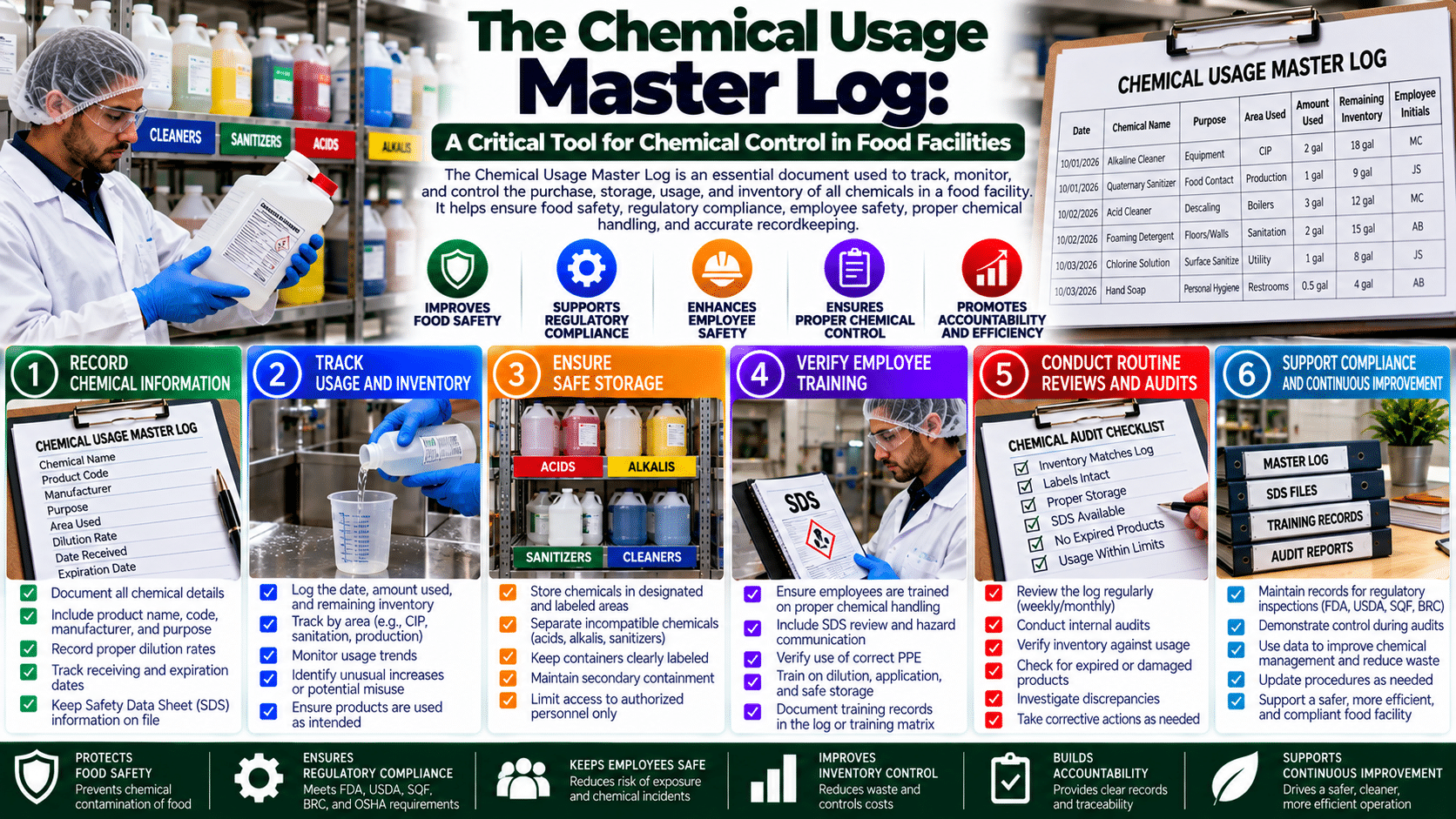

Food safety, sanitation, and regulatory compliance are built on a foundation of effective chemical control. In foodservice and manufacturing environments, a wide array of chemicals is routinely used—not only for cleaning and sanitizing but also for equipment maintenance, pest control, and facility operations. Each chemical carries potential risks if improperly managed, ranging from physical contamination to chemical residue hazards. To mitigate these risks, food facilities must implement a Chemical Usage Master Log—a centralized record documenting every chemical on-site, its intended use, concentration, hazard rating, and revision history.
The Chemical Usage Master Log is more than a compliance tool; it is an operational safeguard. By establishing clear documentation, facilities ensure that employees handle chemicals safely, apply them at proper concentrations, and prevent accidental misuse. This log also supports environmental responsibility by limiting overuse, aligns with Hazard Analysis and Critical Control Point (HACCP) verification, and ensures audit readiness for third-party certification schemes such as SQF, BRCGS, and ISO 22000.
This article explores the importance of a Chemical Usage Master Log, details its essential components, and explains how it supports chemical safety, food safety, and regulatory compliance. It also examines its role in training, hazard communication, sustainability, and continuous improvement within the food industry.
Food facilities use chemicals for various purposes, including:
Each of these chemicals presents different levels of hazard and requires tailored handling, dilution, and application procedures.
Without structured chemical management, facilities face significant risks:
A Chemical Usage Master Log mitigates these risks by providing a single point of reference for all chemical-related information.
The Chemical Usage Master Log functions as a control document that allows facilities to:
By maintaining the log, facilities create transparency and accountability for chemical handling practices.
A well-structured Chemical Usage Master Log should include the following categories of information:
The commercial name and manufacturer information allow clear identification of the chemical. This ensures consistency in ordering, training, and recordkeeping.
A concise description clarifies the chemical’s primary function (e.g., “alkaline detergent for removing protein and fat deposits”).
This section defines where and how the chemical is applied:
Documenting the manufacturer’s recommended dilution ratio ensures the chemical is applied at a safe and effective concentration. For example, “1 oz per gallon of water” or “200 ppm chlorine solution.” This prevents both under-concentration (ineffective cleaning) and over-concentration (hazardous residues).
A physical description—such as “clear liquid,” “white powder,” or “blue gel”—helps employees identify chemicals correctly, reducing the chance of misuse.
Based on the National Fire Protection Association (NFPA) 704 Diamond System, hazard ratings are assigned in three categories:
Ratings range from 0 (minimal hazard) to 4 (severe hazard). For example, chlorine bleach may have Health: 2, Fire: 0, Reactivity: 1.
Logs must include a revision date to reflect the most current information. Updating ensures compliance with manufacturers’ latest safety data sheets (SDS) and regulatory changes.
The Occupational Safety and Health Administration (OSHA) requires employers to maintain a written hazard communication program, including chemical inventories and access to Safety Data Sheets (SDS) for each chemical (OSHA, 2012). The Master Log supports this requirement by consolidating key chemical information into one accessible document.
The Food Safety Modernization Act (FSMA) emphasizes preventive controls, including sanitation. The FDA’s Current Good Manufacturing Practices (21 CFR Part 117) mandate that facilities maintain proper chemical control to prevent food adulteration.
In meat and poultry plants, the USDA Food Safety and Inspection Service (FSIS) requires strict documentation of chemical usage to verify that cleaning and sanitizing agents are approved for food-contact use and applied correctly.
Certification programs such as SQF and BRCGS require comprehensive chemical control programs. Auditors often request to review the Chemical Usage Master Log as part of sanitation system verification.
Chemical control is a prerequisite program under HACCP. A facility cannot adequately identify and control hazards without first ensuring chemicals are used safely and documented properly.
Improper chemical concentrations can affect environmental swabbing results. For example, under-diluted sanitizers may leave microbial residues, while over-diluted chemicals may leave residues that interfere with ATP monitoring systems.
When audits or swabbing indicate sanitation failure, the Master Log provides a starting point for corrective action—verifying whether chemicals were used at the correct dilution and in compliance with procedures.
New employees must be trained on the facility’s chemical control program. The Master Log serves as a reference document to introduce chemicals, their uses, and associated hazards.
Employees should be retrained at least annually, and whenever new chemicals are introduced. Reviewing the Master Log during refresher training reinforces proper practices.
In the event of an emergency—such as a chemical spill or accidental exposure—employees can reference the log to identify the chemical’s hazards and follow the correct emergency protocol.
| No. | Chemical Name | Description | Use | Recommended Dilution | Appearance | Hazard Ratings (0–4) | Revision Date |
|---|---|---|---|---|---|---|---|
| 1 | Chlorine Bleach | Disinfectant and sanitizer | Food-contact surface sanitizing | 200 ppm (1 oz/1 gal water) | Clear liquid with chlorine odor | Health: 2, Fire: 0, Reactivity: 1 | 03/2025 |
| 2 | Quat Sanitizer | Surface sanitizer | Non-food contact surfaces | 1:512 (1 oz/4 gal water) | Blue liquid | Health: 1, Fire: 0, Reactivity: 0 | 03/2025 |
| 3 | Heavy-Duty Degreaser | Alkaline cleaner | Equipment and floors | 1:20 dilution | Yellow liquid | Health: 2, Fire: 1, Reactivity: 0 | 03/2025 |
| 4 | Food-Grade Lubricant | Machine lubricant | Equipment maintenance | Ready-to-use | White semi-solid | Health: 0, Fire: 1, Reactivity: 0 | 03/2025 |
By controlling dilution rates and usage, the Master Log helps reduce chemical waste, supporting environmental sustainability.
Accurate chemical control prevents excess concentrations from entering wastewater systems, ensuring compliance with environmental regulations.
Facilities may use the Master Log to track environmentally friendly chemical alternatives, aligning sanitation programs with corporate sustainability goals.
Regularly updating the log ensures it reflects the latest Safety Data Sheets and industry best practices.
During audits, presenting a complete and up-to-date Chemical Usage Master Log demonstrates compliance, reducing the risk of non-conformances.
Data from the log can be analyzed to track chemical consumption, identify cost-saving opportunities, and monitor chemical-related incidents.
Ensuring every chemical is included in the log requires diligent oversight. Omissions can undermine the entire program.
Even with documentation, employees may default to improper practices if not regularly trained and monitored.
Facilities must designate a responsible person to manage updates, or the log can quickly become outdated.
The Chemical Usage Master Log is an indispensable tool for chemical control in food facilities. It centralizes critical information—chemical identity, purpose, dilution, hazards, and revision dates—into one authoritative document. By implementing and maintaining the log, facilities not only comply with OSHA, FDA, USDA, and GFSI requirements but also safeguard employees, protect consumers, and reduce environmental impact.
The Master Log supports HACCP systems by ensuring sanitation programs are reliable, verifiable, and continuously improving. It strengthens training, simplifies audits, and promotes sustainability by controlling chemical waste.
In an industry where a single misused chemical can jeopardize public health, regulatory compliance, and brand reputation, the Chemical Usage Master Log is not optional—it is essential. A living, well-maintained log transforms chemical management from a compliance exercise into a powerful tool for food safety, occupational health, and environmental stewardship.